A Different Type of Holiday
Posted by Ralph Montesanto
Ralph and Barb Montesanto tie a Rotary Matching Grant to a vacation in China, Tibet, Nepal and India. This is part one of the adventure
A Different Type of Holiday
It has been one year since Barb and I and a group of Rotarians flew to New Delhi, India and then on to the city of Bareilly where we took part in a Limb Camp for polio victims and amputees. That service project was financed through a Rotary Foundation Matching Grant, but as participants we all paid our own way. Well, we did it again this year, but we flew into Kolkata, India. Then we took a 4-hour train ride to the city of Dhanbad where we watched the magic of another Rotary Foundation Matching Grant. This time it financed a corrective limb surgery on severely crippled polio crawlers and another Limb Camp which installed artificial legs and braces on amputees and polio victims. Rotary International's corporate goal is to eradicate polio throughout the world. The Rotary Foundation has already spent $650 million to date to make this happen and polio is now endemic in only four countries: Nigeria, India, Pakistan and Afghanistan. While we were in India this time, we learned that Bill and Melinda Gates pledged $100 million to the cause and challenged the Rotary Foundation to match it with another $100 million. This $200 million might be just what is needed to put the final push on the eradication of this dreaded disease.
But let me go back to the start of this trip. Under the leadership of Past District Governor Terry Youlton from the Rotary Club of Ridgetown, Ontario, we added two weeks of travel before the India experience. We flew into Beijing and took a look at the new Birds Nest Stadium. The city is in the midst of a massive reconstruction of infrastructure as it pushes to be ready for the 2008 Olympic Games. The roads and bridges are new, cars are new and many new buildings are being erected to showcase the city. While in Beijing we went to the Peking Opera. The costumes were ornate and colourful and the high falsetto voices were a new experience. Naturally, while in the area we did the mandatory climb of the Great Wall. The section we climbed is at Badaling and is very steep. It took over an hour of hard climbing to reach the top. Coming down was more hair raising than going up! The entire Great Wall stretches almost 6000 kilometers across China.
We left Beijing and took an 11-hour over night sleeper car train ride to Xi'an. Our Chinese guide misread the boarding time and we were on the run through the station to get to the train before it left. Well, it departed at the scheduled time and left one of us on the platform. The guide did some fast telephone work and our stranded member joined us the next day for lunch. His wife, who was on the train, did not sleep much that night!
Xi'an has a population of about 8 million and November is a time of the year that it is shrouded in fog. That was too bad because the city is very beautiful but it was difficult to see. A lot of the fog is mixed with pollution and might better be termed, smog. Coal is a major source of power and heat in China and many major cities are dealing with the problem. However, at night the fog seemed to lift and the city was awash in neon, looking much like Las Vegas.
Outside Xi'an, we visited the Terra Cotta Warriors. This site was first discovered by a local farmer in 1974 who received 20 yuan from the Chinese government. Then they promptly relocated him and developed the site into a major tourist attraction with the primary excavation covered by a massive building. The warriors and horses were built by the Qin Dynasty in 221 to 206 BC. Each statue was found broken into many pieces. History has an invader destroying the entire army only a few years after it was built. The modern day excavator finds the broken pieces and painstakingly puts each puzzle back together to give the large army that is on display. In 1997 the dig was stopped because the artifacts changed colour once exposed to air. The day we were there, an elderly Chinese man was signing books. We were told he was the original farmer that found the warriors.
From Xi'an we flew to Chongqing, another modern Chinese city, also enveloped in smog. Chongqing is a city of 30 million with about 11 million living in the city centre. The city is more like a regional municipality and covers many square kilometers outside the core. We took a 3-hour bus ride to the city of Dazu, where 1300 year old cliff carvings still exist. They were magnificent statues of Buddha and other gods and protectors. It was amazing that the carvings would still be in such good shape after so many years exposed to the elements.
We left Chongqing for one of the highlights of the trip. We flew over the Himalayan Mountains and landed in Lhasa, Tibet. We needed a special travel permit from the Chinese government to travel to the Tibetan Authority. At one point we were concerned that they might not give permission because several weeks before, the Dali Lama met with Prime Minister Stephen Harper infuriating the Chinese government. Shortly before meeting with the Prime Minister, the Dali Lama also met with President George Bush. Before we left for home we learned that the Chinese government refused the US navy entry to the Port of Hong Kong. The Dali Lama in exile is a very big issue with China.
In any case, we arrived in the capital city, Lhasa, about 4000 meters above sea level. At this elevation a novice to the city does everything slowly as the thin oxygen governs one's speed of action. We took altitude pills and they did help.
Lhasa is a modern city of about 400,000, clearly showing the Chinese influence for infrastructure. A new tunnel cut the driving time from the airport to the city by 40 minutes and the roads and buildings in the new section of the city were new and in good condition. The view down any street reminded me of Banff with mountains everywhere.
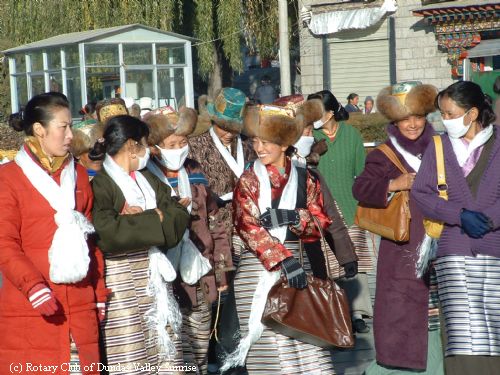
Lhasa was filled with pilgrims. Every Tibetan makes a pilgrimage to the holy city once in a lifetime. They leave their homes and farms for 3 to 4 months and the entire family makes the journey to the Potala Palace which was the main seat of government and religion for the Dalai Lamas, to the NorbulingKa or summer palace of the Dali Lamas and to the Jokhang Temple. Neighbours look after their farms and animals until they return. The favour is then reciprocated as the next family heads to Lhasa. Tibetans are a friendly people and their dress is something right out of a National Geographic Magazine: bright colours, heavy coats, fox skin caps and almost every woman and child wears a mask to protect their face from the cold and the sun.
While in Lhasa we climbed the 300 stairs to the top of the Potala Palace and visited many temples where Tibetan women would place a spoon or two of home made yak butter into the always burning candles. Lhasa is a training ground for monks in the Sera Monastery. The Chinese government has declared that a maximum of 600 are allowed and while we were there hundreds of monks were training in the main atrium. This was a pretty intense type of small group learning where senior monks would teach 5 or 6 junior monks.
Just before we left Lhasa, we had the privilege of visiting a Tibetan home. This family were tailors and earned about 8000 yuan ($1100) per month. They were considered middle class. They invited us to a variety of Tibetan snacks and a cup of yak butter tea and home made beer. The average woman drinks 30 small cups of this tea a day. Many of us found the tea too rich. The beer on the other hand was just right.